Research Presentations

Poster Sessions

CPAK XIV invites researchers to present original work exploring ancient wisdom, cosmic cycles, and the questions that conventional scholarship has yet to answer.

About Poster Sessions

Share Your Research

Poster sessions provide researchers, independent scholars, and students an opportunity to present original work and engage directly with conference attendees during the event. Whether your research is well-established or still emerging, CPAK's poster sessions offer a collegial setting for dialogue and discovery.

Posters are displayed throughout the conference and presenters are available during dedicated session periods. Accepted presenters must attend CPAK XIV and bring their physical poster to display.

📋
Poster Specifications

Posters must conform to standard university poster presentation dimensions:

Size: 3 feet × 5 feet

Presenters are responsible for printing and transporting their poster to the venue. Easels and display space are provided.

Topics of Interest

Preferred Research Areas

The CPAK Poster Committee gives preference to presentations in the following areas, though all relevant research is considered.

Ancient Cultures & Archaeoastronomy Megalithic Structures Myth & Folklore Early Calendar Systems Ancestral Ceremonies & Traditions Anomalous Artifacts Consciousness Studies Physics of Consciousness Precession of the Equinox Lost Civilizations Sacred Geometry Cosmic Cycles
How to Submit

Submission Guidelines

  1. 1
    Prepare Your Abstract

    Write a clear abstract of your research — no more than 800 words. The abstract should describe your research question, methodology, findings, and significance. Include your contact information with the submission.

  2. 2
    Submit by Mail or Email

    Send your abstract to the CPAK Poster Committee by mail or email (see contact details). Submissions are reviewed on a first-come, first-served basis, subject to committee approval.

  3. 3
    Await Decision

    The CPAK Poster Committee will respond with a decision within 30 days of receiving your submission. Most are quickly approved. We like ideas that stretch the imagination!

  4. 4
    Prepare & Print Your Poster

    If accepted, prepare your poster to the required dimensions (3 ft × 5 ft). Print and bring the physical poster to the conference. Display space and easels are provided on-site.

  5. 5
    Register for the Conference

    All accepted poster presenters must register for CPAK XIV and attend in person. Conference registration is required to participate.

✉️
Submit Your Abstract

Email your abstract to:

tara@binaryresearchinstitute.org

Attn: Tara Messier

📬
Mailing Address

CPAK 2026 Poster Presentations
c/o Binary Research Institute
1600 Dove St., STE 480
Newport Beach, CA 92660

⏱️
Abstract Limit

Abstracts must not exceed 800 words and must include your contact information. Submissions exceeding this limit may not be reviewed.

Sample Submission

Example Abstract

For reference, here is a complete sample abstract by Walter Cruttenden — Director of the Binary Research Institute and CPAK co-founder — illustrating the tone, scope, and structure expected of a poster submission.

Sample Poster Abstract

Cycles in Consciousness — An Ancient View

by Walter Cruttenden

According to Giorgio de Santillana, the former professor of the history of science at MIT, over 30 ancient cultures believed consciousness would rise and fall over long periods of time. In his landmark work, Hamlet's Mill, Giorgio and co-author, Hertha von Dechend, document how the myth and folklore of ancestral people describe a cycle of alternating "Dark and Golden Ages". It was believed that in the higher ages, mankind's consciousness was equivalent to a "demi-god or god," whereas the lower ages would bring man back to his "mortal or material" state. Plato called this cycle "the Great Year".

While historians recognize a classical Dark Age period, they do not recognize any prehistoric "Golden Age" as described by Hesiod and other ancient cultures. Consequently, most of us were taught this idea of a "Great Year" is just a fairy tale. However, new astronomical and archaeological evidence suggests the cycle may have some basis in fact. If true, an understanding of the ancient beliefs might provide insight into whether or not world consciousness has any cyclical aspect, and if so, where consciousness may be headed today.

The ancient view of world consciousness was tied to celestial motion. Interestingly, new research shows the body's adaptation to the Earth's diurnal motion is the major factor causing human awareness to move from a conscious state to subconscious state (sleep), and back to a conscious state again, every day. Likewise, we know that Earth's annual motion around the Sun produces dramatic changes in the Earth, affecting the migration and reproduction pattern of billions of life forms, as well as the mood and adaptability of the human species. Thus, if there is another celestial motion as some ancient cultures believed, and some modern scientists suggest, then it is possible that this might affect life and consciousness on a broad yet subtle scale.
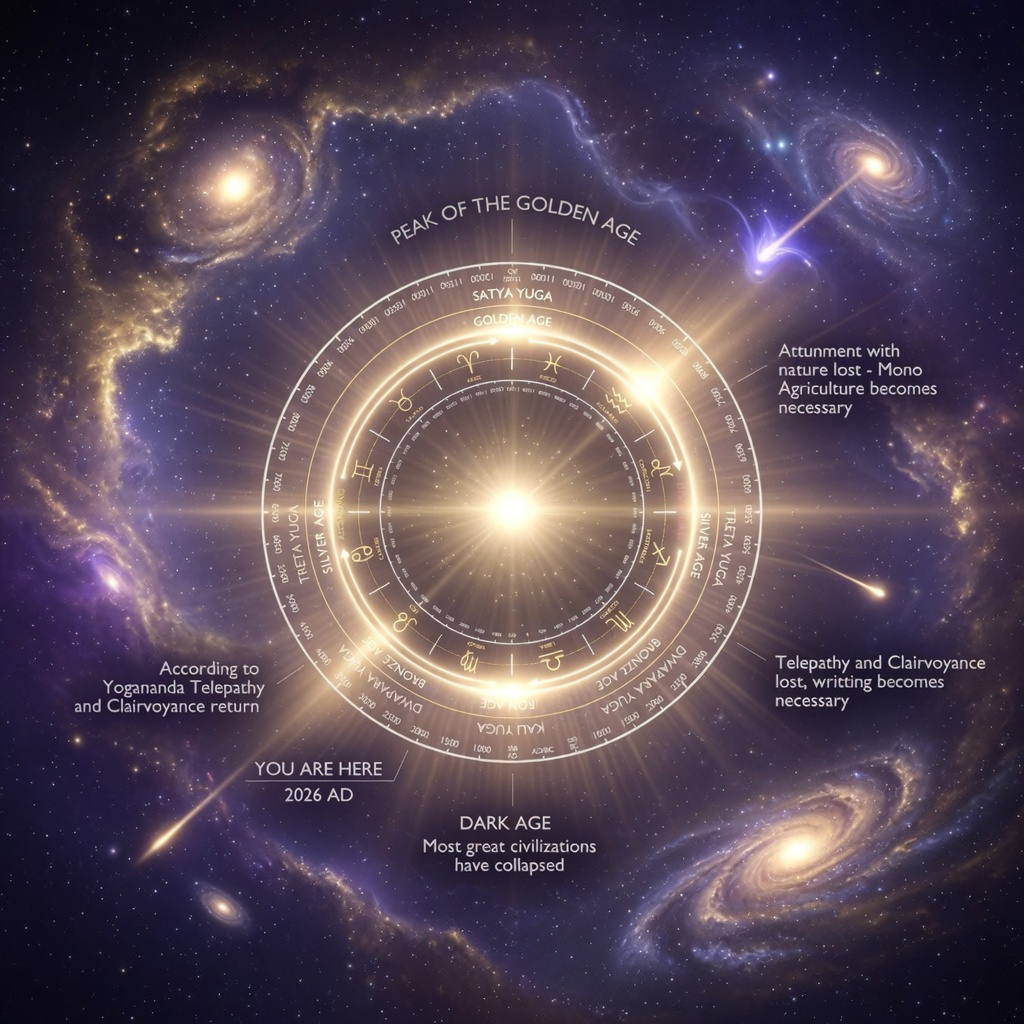
The Cycle of the Ages — Yugas, Great Year, and the precessional movement through the Zodiac
The Cycle of the Ages — Yugas, the Great Year, and the position of our current epoch.

The hypothesis for how consciousness would be affected in such a celestial cycle builds on the work of Dr. Valerie Hunt, the former professor of physiology at UCLA. In several studies, she found that changes in the ambient EM field (produced by the Earth and the Sun) can dramatically affect human cognition and performance. In short, consciousness may be mildly affected by proximity to EM fields. Consequently, the theory behind the Great Year or cyclical model of consciousness and history, consistent with myth and folklore, is based on the motion of the Sun through space, subjecting the Earth to waxing and waning EM fields, resulting in the legendary rise and fall of the ages over great periods of time.

Join us at the next CPAK as we explore a few of the ancient myths about rising and falling ages tied to a modern astronomical motion and refine the hypothesis for how a change in proximity to stellar-generated energy fields might be the mechanism that induces cyclical changes in the Earth's ionosphere, magnetosphere and possibly consciousness itself.
The Conference CPAK XIV — Conference on Precession and Ancient Knowledge seal

An ongoing inquiry into precession, antiquity, and the cycles that shape civilization.